
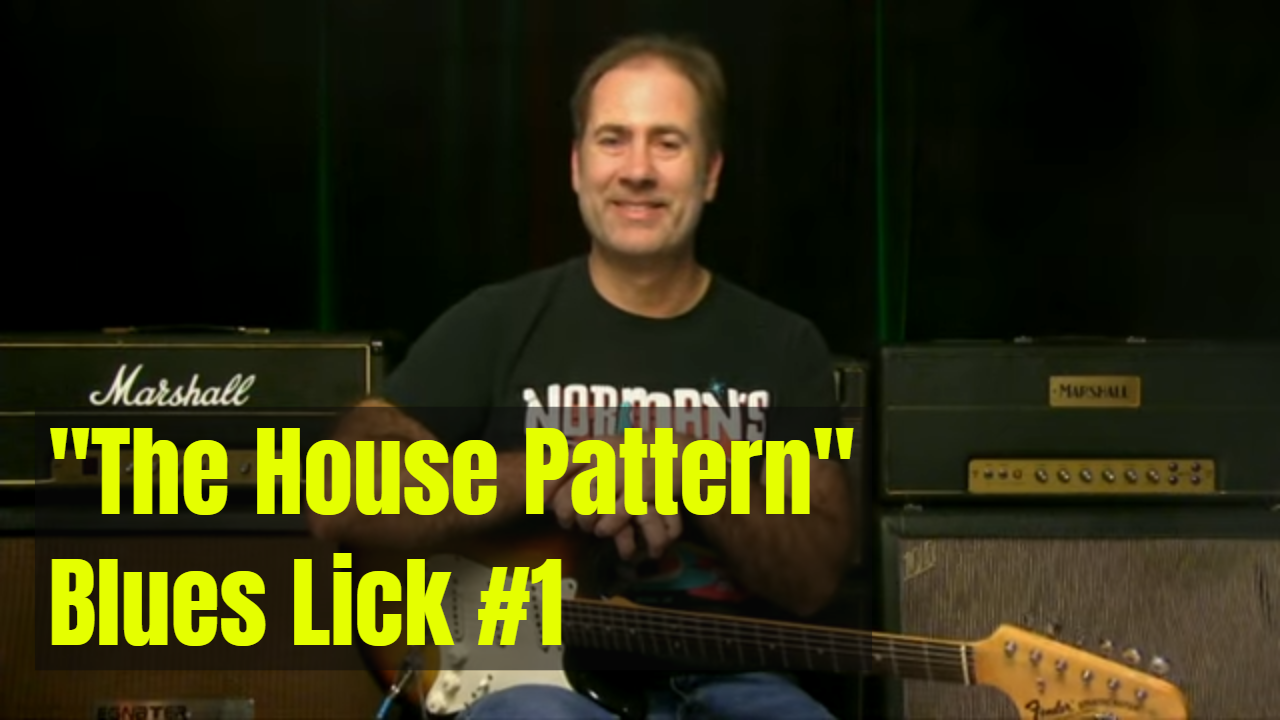
Let’s learn a fun new lick from one of my favorite patterns, the “House Pattern.”
Check it out, this is a classic pattern for mixing the major and minor blues sounds without having to turn your fingers all around!
And if you dig it, check out my “The House Pattern” course as well for a lot more licks and how this pattern works with your regular “box” patterns as well.
Downloads:
Here’s the Jam Track – MP3
Here’s the TAB – PDF

11 replies to "THP 2 House Pattern Lick 1"
Thanks Griff! Love your classes!
Hi Griff,
I Love using this pattern but when I use the pentatonic scale in A the house pattern starts on the 8th fret. Isn’t this lesson using box 2 of the B pentatonic scale? Could you explain why it is in A or works with A. Or what I am missing. Thank you. Gary
Griff can elaborate… but to the best of my understanding, the 8th fret string 2 is the 7 of the scale. In this house dwells the minor pentatonic
Starting on the 10th fret, we have the same shape but holding the major pentatonic.
Your explanation is the basis for Google AI’s interpretation of the House Pattern:
The “House Pattern” (The B-B or Box-Box Pattern)
What it is: A targeted fretboard navigation concept— popularized in blues and rock instruction (such as Blues Guitar Unleashed)—that bridges the gap between positions.
The Shape: Visually, the notes played create a shape that resembles a little house on the fretboard map, which sits adjacent to your standard Minor Pentatonic Box 1.
Usage: It allows you to access major pentatonic notes immediately adjacent to standard minor pentatonic positions. This gives you an easy way to slide “in and out” of major and minor sounds without having to jump your hand all the way across the neck.
The House Pattern, with the 1 2 4 5 6, is neither a complete Major or minor pentatonic scale. You can achieve the missing 3rd by bending the 2 up to b3 or 3.
And can add other notes from Major Box 4 or minor Box 3.
You could play the b3 and 6 for the “Pentatonic 6” sound.
Or a Dorian or Mixolydian or any other scale you can visualize within the surrounding area.
And, yes, the House Patten on A played from B is the B minor pentatonic scale Box 2 as well as the D Major played from D on the 1st string.
But from the root on A you have the versatility of playing either a Major or minor sound simply by bending the 2.
This is a good lesson. I used to think there was no hope for me, but my counting is actually improving from doing these lessons. I am even starting to count out other songs I work on. I am slow at it, but one day I will count like Griff.
Another side benefit I found for counting is that if you find a piece of music that seems uncountable, it probably is and it’s probably wrong. Counting is also helping me weed out bad sheet music and tab. The internet is full of it.
I’m SOOOOO happy to hear this!!! And you are so right about the internet being mostly wrong, and rhythm is an easy way to tell.
I ordered your full house pattern course since this is a very key part of playing the blues and understanding the house pattern as well. I have lots of your other courses as well, but this course has a unique focus, which is great.
I love the bite sized lessons and jam tracks! So fun. Thanks from a newbie!
Thank Griff
Love these lessons!
Been with you forever and your lessons continue to amaze!@
Thanks for the quick lesson Griff. I can use it and truly enjoy.