
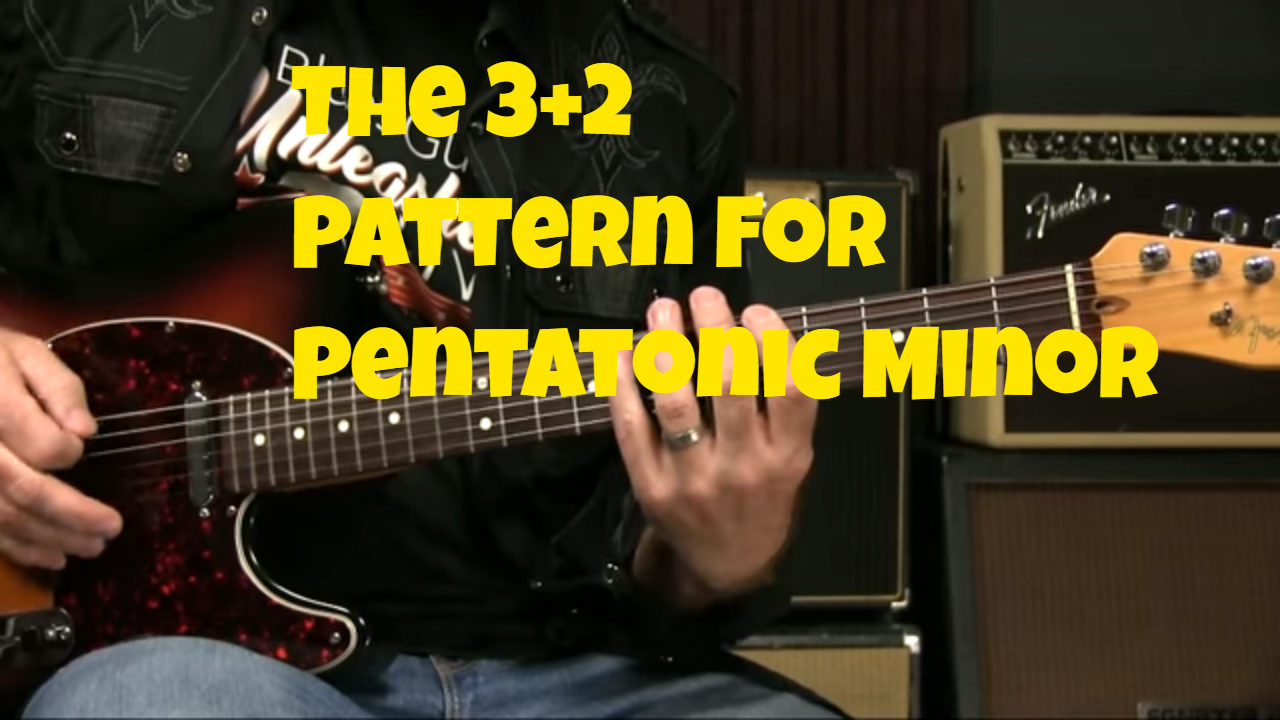
This pentatonic minor pattern is one of my favorites for a couple of different reasons…
First, it’s easy to remember because you play the same thing over and over again – the whole pattern is only 2 strings 🙂
But also, it’s cool for a “get up and get out” from where you’re currently playing. You can get across the fretboard almost immediately to a new area.
Enjoy and experiment with it!

49 replies to "The 3+2 Pentatonic Minor"
Guess I’m just too much of a beginner. Very convoluted.
Not sure why you start on the fifth fret of the sixth string when a person could just play an open A.
Don’t think I follow this well. Then suddenly it goes to D.
Notation or a tab might be my level
Addendum to previous comment.
I don’t know boxes so I appreciate your talent very much.
This **3+2** pattern is different from *another 3+2* pattern published with Griff’s “5 Easy Blues Solos” manual. Confusing, as the “5EBSolos” *3+2* pattern reflects a *Major* Pentatonic scale across the fretboard, whereas the **2+3** pattern (same publication) reflects a **Minor** Pentatonic scale. Both versions (**3+2** vs *2+3*) get you across the Minor Pentatonic fretboard, but a little bit differently. I guess it depends on whatever works for you individually, but from a purely “nomenclature” standpoint, it’s very confusing!
(I noted above that others use the same sequences (3+2 vs. 2+3) as the 5EBSolos has it.)
(Oh) danny (boy!)
An “aha” moment! I think we’ve all heard that “pattern” used in various tunes. For me Dickey Betts comes to mind. Took a couple times to view but it’s now burned in.
HEY GRIFF
I like it but need to see standard notation and tab could help.
Would you send it to me
Thx Guitar Bonk
Barry, I just created the notation for this (up and down). Will be happy to send it to you if you email me… rmabiz07@gmail.com
(and others…)
Sorry… I wrote TAB (not notation!)
Great job Griff great job Griffin
Progresses too fast for me. Not enough repetition to make it sink in before you go on to the next step. I’m lost, lost, lost. I’ve been playing guitar for 40 years, but can’t find a guitar instructor who teaches in such a way that I can absorb the new information and move on from what I already know.
Katherine, It might help you to see some fretboard visualations. Do a google images search for Pentatonic Extensions, which is what Griff is teaching here. You will find diagrams for the 2 + 3 extensions and also the 3 + 2 extensions that is shown here. Another term you can google would be Diagonal Pentatonid Extensions. For this lesson and the other 2 + 3 extension you will be playing the 5 notes of the pentatonic scale and as you change string pairs ( Strings 6 & 5; 4 & 3; 2 & 1 going lowest to highest) you will be playing the notes of the pentatonic scale in different octaves.
Use Google and pull up a complete fingerboard chart of the minor pentatonic scale for whatever key you want. Use those notes to work on lead ideas.
that diagram doesnt work for this example.
Me to!
I am in a very similar place, at age 77 and just having returned to guitar after 50+ years of not playing so well as a kid. Want to learn blues, jazz, fingerpicking… Bought Griff’s “50 licks” which I started yesterday… they are above my pay grade, but will practice them and see if I can have them “click in.” I am also learning “Sultans of Swing,” which I LOVE… and starting to make good progress on the two solos. Difficult song overall, even playing the chords… Giving up is no longer an option… Creativity demands that we work through the “lost”times, but nobody told me they would last and last and last!
I’m old…need Tab.
Barry! It might help you to see some fretboard visualations. Do a google images search for Pentatonic Extensions, which is what Griff is teaching here. You will find diagrams for the 2 + 3 extensions and also the 3 + 2 extensions that is shown here. Another term you can google would be Diagonal Pentatonid Extensions. For this lesson and the other 2 + 3 extension you will be playing the 5 notes of the pentatonic scale and as you change string pairs ( Strings 6 & 5; 4 & 3; 2 & 1 going lowest to highest) you will be playing the notes of the pentatonic scale in different octaves.
Steve, Thanks for this post – I will check these out. Yes, I have studied the pentatonics up and down the fretboard but want to “break out” so as to better understand and play these licks. The bends are a challenge as well…
I learned this from just messing around several years ago. I like the way it allows one to go horizontally up and down the keyboard. Thanks for the vid as it now has a name I can call it.
Griff, you are without a doubt the best teacher on the internet. Your explanations are clear and precise. Thanks for all you do!
You da MAN! Appreciate all you do.
Good stuff Griff! Thanks!
Very cool stuff, like this pattern a lot. I find that I practice in A or G much of the time with scales because of the “real estate” issues in D…this helps to keep it interesting to get to Box 1 in D rather than starting in it.
Wish you had provided a tab for this. Tabs make learning and retaining much more effective – even for something so apparently simple as this.
agree
That’s a great comment.
Thanks, Griff. What this exercise is actually doing is horizontally sliding between boxes on a repeating pair of strings.
Almost skipped over this as I thought it was the 2+3 I picked up from one of your other emails. This one is not only great for relocating up the neck but its also an awesome little finger workout! I’m sure I’m not the only one who has less control of their little finger than I do of the rest and this will help. No tab needed use your ears another thing we all probably need to spend more time on Great one Griff!
I almost did the same thing!
You may not need tab, you may have an ear for this, some of us just don’t and need the extra help!
If a person has problems using the little finger just slide into the notes where there are 3 notes on one string. You can also play sequences using these patterns which really sounds good.
thank you griff,for taking the time to teach us simple little tricks that you have up your sleeve,great lesson
Great Video….I like to jam to the B Minor of lesson 20 solo example#2 in Blues Guitar 2.0. I jam to it every night as it sounds like BB King and goes great with the Lessons from the Masters licks and every other lick that covers walls in my apartment making jamming so easy as I walk around and just look at the wall. I just got my course on Strumming and Mastery so I am taking that slow cause I got to learn this counting thing as I just mimick the sounds I hear…
Nice I’d we had the tab to help cement finger progressions..thanks Griff!
Do Google Images search and you can find these shapes shown.
Thx Griff. Great lesson!
Great lesson as usual griff. I will work on this, what a great tool for the bag!
This pattern reminds me of Hendrix’s Castles Made Of Sand. Thanks Griff.
A light just went off with this one! One of your best lessons.
Why no download?
No tab?
Hey Gruiff I was wondering do you have any information on what and how to use paddles, I’ve got a few but not sure how to hook them in the correct place. As you know you know I’ve gotten a few items from you.
Good stuff! I have been using this for awhile but I learned it a little differently. For minor Pentatonic, I do the 2+3 version, where I use my ring finger on the root note. In the key of A, I play the G and A on the sixth string, then move to the 5th string to play C – D – E, repeating up the strings and neck. Every note is two frets away from the previous note. For the major pentatonic I use the 3+2 (A – B – C#) and then (E – F#) repeating each set of strings. But…I’m still going to try Griff’s approach to the minor pentatonic to see how it compares.
Find an image of the Am fretboard and plot these diffferent shapes on them,, I use a highlighter to show the desired notes played. Great visualizations.
Brian M. the 3 + 2 Diagonal Scale you mention using as a Pentatonic Maj. extension can be converted to a Minor scale by starting on the 5th string and playing a 2 + 3 form on the string pairs 5 & 4 and string pair 3 (g-string) and 2 or B-string and continue onto the 1st string to complete the scale. Same notes as the 2 + 3 pattern you descibe.
This was the first blues pattern I figured out when was first becoming aware of the Blues in my 20s. I knew nothing about keys nor boxes. I just played along with records and found it worked.
Kool lesson,
Always learning good stuff Griff
I went straight over to my guitar and started to use 3plus2 and played around with it. What a great lesson. Fits in with the modes lessons too. I like having a highway up to the 12th fret for something in G. And, breaking that into bits and pieces or starting from the 4th string G root. Such a great little tool.
The flow of this piece is very helpful. I truly appreciate your method of teaching. It allows us to think for ourselves and create something that is specifically our own.
Rob
Nice easy pattern to play with thank you these little extras go so well with your course
And your concept of teaching
Jack