If Your Blues Solos Don't Sound Like Solos...
You Probably Don't Need More Licks
The real reason most guitarists can't solo — and a surprisingly simple afternoon fix
Dear Fellow Guitar Player,
You know the minor pentatonic scale.
You've learned some blues licks. Maybe quite a few.
You can noodle around and hit notes that technically work.
But then somebody puts on a jam track. Or you're at a session and it's your turn. And what comes out isn't a solo — it's just... notes. A bunch of notes going nowhere.
So naturally, you figure you must be missing something.
More scales. More boxes. More licks. Maybe some theory you haven't learned yet.
Here's the thing: you're looking in exactly the wrong place.
If I limit myself to just four notes — not a scale, not a box, not a collection of licks — four notes — I can play a convincing blues solo. Which means the notes were never the problem to begin with.
The problem is what you're doing with them. When you play them. How you play them. And whether you had any idea what you wanted to hear before your fingers started moving.
That's what The Blues Soloing Fix is about.
Most Guitar Players Look In The Wrong Direction
And honestly, it makes perfect sense. When something isn't working, you go looking for what's missing. Your solo doesn't sound right, so you figure you must need more — more scales, more boxes, more licks, more theory.
The guitar lesson industry is more than happy to oblige. There's no shortage of courses, YouTube videos, and tab books promising to give you more stuff to learn.
But here's the thing nobody tells you:
More notes don't fix the actual problem.
Think about it this way. If the notes you have access to were really what was holding you back... then someone with fewer notes should sound worse than you. That logic should follow.
Except it doesn't.
You've heard players like Albert King, Jimmy Vaughan, Robert Cray — guys who built entire careers, entire identities, out of a remarkably small collection of notes. They weren't sitting on some secret stash of scales you don't have access to. They were just doing something completely different with the notes they had.
The real problem isn't your notes. It's what you're doing with them.
Specifically, it's two things almost every struggling blues guitarist ignores completely:
When they play those notes. And how they play them.
Most players put 100% of their attention on what to play. What scale. What box. What lick. What note over this chord. And while their fingers are busy searching for the "right" notes, the two things that actually make a solo sound like a solo — rhythm and intention — go completely unaddressed.
That's not a knowledge problem. It's a focus problem. And it's fixable.
Here's What Makes This Different — And Why I'm The Right Person To Show You

My name is Griff Hamlin, and I've been teaching guitar for nearly 40 years. In that time I've worked with thousands of students, and I've watched this same pattern play out over and over again.
A guitarist posts a video online asking for feedback. They get a hundred comments. "Try this scale." "Learn more licks." "Work on your theory." Everyone has an opinion, and almost every opinion points in the wrong direction.
Here's what I know from nearly four decades of doing this: I can watch someone play eight or ten notes and tell you exactly what their problem is. Not a general impression — the specific thing that's breaking down and what to do about it.
And in the overwhelming majority of cases, it's the same two things: no sense of time, and no use of space.
Not a lack of licks. Not the wrong scale. Not insufficient theory.
Time and space.
That's the diagnosis almost nobody ever gets — because most people teaching guitar are focused on what to play, not on why the playing doesn't sound musical. I've built The Blues Soloing Fix around that diagnosis. Every step of this course is designed to help you find your specific version of that problem — and hand you a clear prescription for fixing it.
Introducing: The Blues Soloing Fix
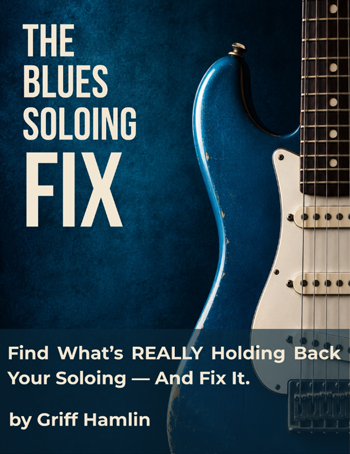
This is not another lick course.
There are no scale diagrams to memorize. No boxes to learn. No tab to work through. In fact, in the entire course I only teach you three small moves — four notes each — and that's completely intentional.
Because this isn't about giving you more to learn. It's about helping you understand why what you already know isn't working. And then handing you a clear, specific prescription for fixing it.
Here's the framework the whole course is built on. Every blues solo — every good blues solo — has three ingredients:
What you play. The notes, the scale, the licks. This is where 99% of struggling guitarists put 100% of their attention.
When you play it. The rhythm. The phrasing. Where your ideas start and stop. How much space you leave. This is where most solos actually fall apart.
How you play it. The slides, the bends, the attack, the dynamics, the duration of a note. This is what separates someone who's playing notes from someone who's saying something.
Throughout The Blues Soloing Fix, I deliberately make the what as simple as possible — just four notes — so you can stop worrying about it entirely and put your attention where it actually matters.
And then there's a fourth ingredient that ties it all together:
Intention. Knowing what you want to hear before your fingers move.
Most guitarists move their fingers and accept whatever comes out. What we're going to do is reverse that. You're going to hear something first — even something tiny, even just one note — and then your fingers are going to go find it. That shift alone changes everything.
Here's Everything You Get
7 Step-by-Step Video Lessons
The entire course runs about two hours — designed to be watched in a single afternoon. Each lesson builds on the last, walking you through the complete framework: What, When, How, and Intention. You'll have a guitar in your hands the whole time, trying things for yourself as you go — because that's the only way any of this actually sticks.
29 Jam Tracks
These aren't just background music. They're the actual tool you use to do the work. You get tracks in multiple tempos and both straight and swing feels — so you can find exactly the speed and groove where your particular rhythmic limits start to show up. That's the whole point.
The Blues Soloing Fix PDF Manual
A companion guide you can keep open on your music stand or print out. Everything you need in one place.
Lifetime Access Through The Member Portal
Come back to it whenever you want. Pick up where you left off. Revisit a section when something clicks differently six months from now — because it will.
Here's What Students Are Saying
"This has been the revelation!!!"
— Jeff T.
"My improvement has been 10 fold in improving my speed and accuracy."
— Bret
"It has always been in my DNA to NOT pay much attention to the talk of scales, modes and boxes... Now, feeling better about what has always been my approach. If I had this session several years ago I may have gotten here with much less stress."
— Marc V.
"I feel the distinct timings so much more clearly in my head, and then my hands. Very cool."
— Michael C.
"I got interested in your teaching because you are the 'counting guy' — so thank you for being so adamant on the subject."
— Jeff R.
"It just dials in the rhythm."
— Frank
Here's What This Is Going To Cost You
I want to be straight with you about something.
This course is listed at $19. That's it. Not $97, not $197. Nineteen dollars.
Here's why I'm doing this: I built The Blues Soloing Fix because I got tired of watching good guitar players spin their wheels for years — buying course after course, learning lick after lick — when the actual problem could be identified and addressed in an afternoon.
This is that afternoon.
For just nineteen bucks — the price of a pizza you'll forget about by tomorrow — you can find out exactly what's been standing between you and the blues solos you've always wanted to play. And unlike that pizza, this isn't going away. You get lifetime access to everything through the member portal. Come back to it whenever you want.
Is This For You?
If you're looking for a course that's going to hand you 50 new licks and send you on your way, this isn't it. There are plenty of those out there.
But if you've been playing for a while — or even if you're relatively new — and you know enough blues to try but can't figure out why it's not working... this was made for you.
You're not missing information. You're missing a diagnosis.
By the end of this afternoon, you'll have one.
Lifetime access. Instant delivery. 7 video lessons, 29 jam tracks, and a PDF manual —
everything you need to figure out what's actually holding your blues soloing back.
To get your complete copy of 20 Turnaround and Ending Licks just click the yellow “Add To Cart” button below. Within moments of your order being complete you will receive access instructions to the Member Portal via email. So you can be playing the blues in just a few minutes from right now