Finally Master The Solos You've Been Listening To For Decades
Learn To Play—And Truly Understand—David Gilmour's Most Iconic Guitar Solos (And Absorb His Legendary Style Into Your Own Playing)
Do you remember the first time you heard the soaring, emotional guitar solo in "Comfortably Numb"?
Or that haunting, melodic phrase in "Shine On You Crazy Diamond" that seemed to hang in the air like a question waiting to be answered?
If you're like most guitarists over 50, David Gilmour's playing isn't just music to you—it's the soundtrack to your life. Those solos have been with you through decades of memories, moments, and milestones.
And if you've ever picked up your guitar and tried to play one of those iconic solos yourself, you know the frustration:
The tabs are there. The notes are right in front of you. But somehow... it just doesn't sound right.
You're Not Alone—And It's Not Your Fault
Here's what typically happens when even experienced guitarists try to learn David Gilmour solos on their own:
You find tabs online or in a book. They might even be accurate (though often they're not). You start working through them, finger by finger, note by note.
You watch YouTube tutorials. Someone plays through the solo with tabs scrolling underneath. You try to follow along, mimicking what you see.
But when you try to play it on your own—without the video, without someone else playing—it falls apart.
Why?
Because you're mimicking the notes, but you don't actually know when anything is supposed to happen.
You don't understand the rhythmic structure. You don't know how to subdivide the beats. You can't feel where the phrases begin and end.
And here's the thing that nobody talks about: David Gilmour's solos were often improvised in the studio. Some notes don't land exactly on the beat. Some phrases have a loose, flowing quality that makes them sound incredible—but nearly impossible to learn from standard notation.
In fact, improvised phrases like these are often borderline impossible to even notate, let alone learn from that notation. The timing is loose, the feel is organic, and trying to capture it with dots on a page just doesn't work.
This is why the timing matters so much.
Let me tell you a story that illustrates this perfectly:
I had a student who struggled with the same solo for over two months. He came to lessons every other week. I kept explaining the counting, trying to get him to understand the rhythmic breakdown.
He kept fighting me on it.
He couldn't even get through the first four bars.
Then he finally bit the bullet and started counting the way I taught him.
He learned the entire 24-bar solo in two weeks.
The Missing Piece: Understanding What Was Actually *Meant*
Two months versus two weeks. That's the difference between struggling with notes on a page and actually understanding the rhythmic foundation of what you're playing.
But here's something even more important:
When you learn these solos the right way—with proper rhythmic breakdown and true understanding—you're not just memorizing finger positions.
You're learning to see the fretboard the way David Gilmour sees it.
You're understanding which scales he uses, which arpeggios he favors, which patterns he moves between, and why.
You're discovering techniques like the call-and-response between low and high positions on the fretboard—things you'd probably never pick up on your own, but once you see them, you can use them in your own playing.
This is what separates my approach from every tab book and YouTube tutorial out there:
I don't just show you where to put your fingers. I show you how to think like David Gilmour.
And that means taking what was actually played—sometimes loose, sometimes improvised, sometimes not perfectly aligned with the beat—and interpreting what was meant.
See, when guitar solos get recorded, they're usually improvised on the spot. Some things may not be exactly perfect. They're not necessarily wrong, but they're not perfectly aligned with the beat either.
That's what makes them sound cool and human and emotional.
But it also makes them really hard to learn.
If you don't know how to take that organic, improvised performance and turn it into something learnable—something you can count, subdivide, and internalize—you'll always be stuck mimicking without understanding.*
That's my specialty. That's what I've been doing for nearly 40 years as a guitar instructor.
What Makes This Course Different

My name is Griff Hamlin, and I've been teaching guitar for almost 40 years. I'm the founder of Blues Guitar Unleashed, which has helped over 70,000 students around the world since 2008. I also have a Billboard-charting blues album from 2019.
But here's what matters most to you:
I've built my entire teaching career on one principle that nobody else seems to focus on: rhythmic breakdown.
Not just showing you what to play. Not just playing along while you watch.
Actually breaking down the timing, the counting, the subdivision of beats—so you know exactly when everything happens.
This is where students come when they really need to understand how things work.
And I've been a David Gilmour fan for over 40 years, just like you probably have been. His playing has been part of my life since I was young, and I've used his solos in my teaching for decades—specifically because they're perfect for teaching melody, phrasing, bending, vibrato, and all the subtle techniques that separate good guitar players from great ones.
When my students started asking me when I was going to create a David Gilmour course, I knew exactly which solos to choose and why.
This course exists by request—because guitarists like you have been asking for it.
Introducing: "How To Solo Like David Gilmour"
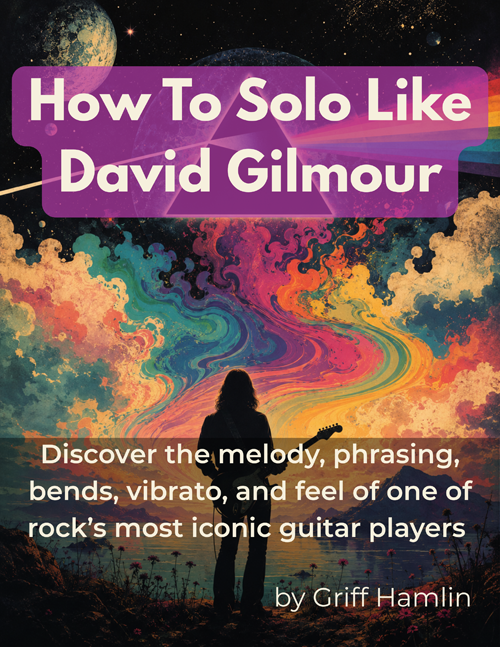
This is not another tab book. This is not another "watch me play and try to keep up" YouTube video.
This is a complete, step-by-step video course that teaches you seven of David Gilmour's most iconic solos—chosen specifically because each one highlights a different aspect of his legendary playing style.
Here's what you're going to learn:
The 7 Solos:
Each solo was chosen because it focuses on a specific element of Gilmour’s playing. I made an effort to cover all of the important elements of his playing as efficiently as possible.
We’ll look at solos in the styles of:
Money
Underneath, it’s a blues in B minor, not unlike “The Thrill Is Gone.” But it’s got a swing (and it’s the only solo here that does.)
Time
Killer blues/rock licks during the first half, followed by beautiful diatonic melodies in the second half. Plus some gorgeous bends.
Shine On You Crazy Diamond
The only 12/8 feel of the bunch and a wonderful example of call-and-response in a way you’ve likely never seen before.
Another Brick In The Wall
Aside from some of the most iconic bends ever recorded, there are so many great classic rock licks here that you can use over and over again (I do!)
Comfortably Numb (Solo 1)
Arguably one of the greatest, most melodic solos of all time, and one of the few “chord chasing” solos he does.
Comfortably Numb (Solo 2)
You will simply love the long and winding phrases in this solo. But if you don’t understand how to subdivide the beats the way I’ll show you, it would be a tough one.
On The Turning Away
The most modern example, it’s also some of his more aggressive playing and shows off his tremolo arm usage.
And when you're done, you won't just be able to play these solos note-for-note.
You'll understand the principles behind them—so you can incorporate Gilmour's brilliance into your own playing.
Here's Everything You Get:
20 Complete Video Lessons:
Complete Visual Learning System:
Supporting Materials:
The Techniques You'll Master
These aren't just seven random solos. Each one was carefully selected to teach you specific elements of David Gilmour's playing that you can use in your own solos:
Quarter Note Triplets - That distinctive rhythmic feel that shows up in blues, rock, metal, and jazz. Gilmour uses them masterfully, and you'll finally understand how to count them and feel them.
Bending Technique - Not just bending to pitch, but bending with emotion, control, and intention. You'll learn when to bend sharp, when to pull off after a bend, and how to make your bends sing.
Vibrato and Sustain - The secret to making notes breathe and come alive. Gilmour's vibrato is instantly recognizable, and you'll develop this skill throughout the course.
Phrasing and Space - Learning when NOT to play is just as important as learning what to play. Gilmour is a master of leaving space, and you'll understand how he creates tension and release.
Call-and-Response Patterns - Moving between low and high positions on the fretboard to create musical conversations. This is something you'd probably never notice on your own, but once you see it, you'll use it everywhere.
Scale and Arpeggio Integration - Understanding which pentatonic boxes, major scales, and arpeggios Gilmour uses and when. You'll see the fretboard the way he sees it.
Melodic Note Choice - Why certain notes work over certain chords, including "wrong" notes that somehow sound perfect in context (like that Dorian sound that technically shouldn't work but absolutely does).
Tremolo Bar/Whammy Bar Techniques - And if you don't have a tremolo bar, no problem—you'll learn how to achieve similar effects with finger vibrato.
Time Feel and Groove - From the swing feel in "Money" to the 12/8 feel in “Time” to the double time in “On The Turning Away,” solos, you'll develop a deep understanding of how Gilmour locks into the groove.
These techniques don't just apply to these seven solos.
Once you understand them, you can use them in ANY solo you play.
That's the real transformation here. You're not just learning songs. You're absorbing a style, a approach, a way of thinking about the guitar that will elevate everything you play.
Is This Course Right For You?
This course is perfect for you if:
This course is NOT for:
"But I Could Just Find Free Tabs or YouTube Videos..."
You absolutely could. And I encourage you to try.
Seriously.
Go find the tabs. Watch the YouTube tutorials. Spend a few weeks trying to piece it together on your own.
And when you're done—when you realize you can mimic it while the video is playing but it falls apart the moment you try to play it on your own—come on back.
I'll still be here.
Because here's what happens every single time:
You can follow along. You can get your fingers in roughly the right places. You might even sound okay while someone else is playing with you.
But the moment you try to play it solo, just you and a backing track, it falls apart.
Why?
Because you don't actually know when anything is happening.
You're guessing. You're approximating. You're hoping.
And that's not the same as knowing.
That's not the same as understanding.
That's not the same as being able to get on a stage, play "Comfortably Numb," and have everyone watching say, "Wow, that sounds like David Gilmour."
Your Complete Risk-Free Guarantee
Here's my promise to you:
Get instant access to "How To Solo Like David Gilmour" right now. Go through the course. Work on the solos. Apply the rhythmic breakdown techniques.
If for any reason—any reason at all—you're not completely satisfied, just let me know within 90 days and I'll refund every penny.
No questions asked. No hoops to jump through.
And because this is a digital course, you don't even have to send anything back. You keep lifetime access to everything even if you request a refund.
Why am I so confident?
Because I've been doing this for nearly 40 years. I've helped over 70,000 students around the world. I know this approach works.
I know that when you finally understand the rhythmic foundation of these solos, everything clicks into place.
The only risk is waiting another month—another year—and still not being able to play the solos you've been listening to for decades.
Here's How It Works
Step 1
Click the button below and complete your secure order. Your investment is just $99—less than two private lessons, and you get lifetime access to everything.
Step 2
You'll receive instant access to your member portal. If you already own any of my other courses, it's the same login—your new course will be waiting for you immediately.
Step 3
Start with the introduction video, then dive into your first solo breakdown. Use the on-screen looping feature to practice difficult sections. Download the videos and PDF manual if you want them on your device.
Step 4
Work through each solo at your own pace. Practice with the play-along videos. Use the jam tracks to test yourself.
Step 5
Within 2-3 months of consistent practice, you'll be playing these iconic solos with confidence, understanding, and the authentic David Gilmour feel.
You're Never Alone
When you join "How To Solo Like David Gilmour," you're not just getting videos and walking away.
You get complete support:
- Email support: helpdesk@bluesguitarunleashed.com (monitored every single day)
- Phone support: 1-877-66BLUES (662-5837) (yes, real human beings you can talk to)
- Member forum: Connect with Griff directly, other Blues Guitar Unleashed students, ask questions, and share your progress
You're joining a community of over 70,000 guitarists worldwide who are on the same journey you are.
The Choice Is Yours
Right now, you're at a crossroads.
Path One: You can close this page and go back to what you've been doing. Maybe try another YouTube tutorial. Maybe buy another tab book. Maybe spend another few months—or years—struggling with solos that never quite sound right, never quite feel right, because you're missing the rhythmic foundation that makes everything work.
Path Two: You can make a different choice today.
You can finally learn these iconic solos the right way—with complete understanding, proper timing, and the ability to incorporate David Gilmour's techniques into your own playing.
You can experience that moment of pride when you nail "Comfortably Numb" from start to finish.
You can feel the thrill of playing along with the records you've loved for decades—and actually sounding like David Gilmour.
You can even get on stage someday and play one of these solos, knowing that everyone watching will recognize it instantly and think, "Wow, that sounds just like the record."
This is completely within your reach.
You have the experience. You have the passion. You've loved this music for decades.
All you need is the right instruction—the kind that breaks down the timing, explains the why, and shows you how to think like David Gilmour thinks.
Here's What Happens Next
Every day you wait is another day you're not playing these solos.
Another day of frustration with tabs that don't explain the timing.
Another day of watching YouTube videos that show you where to put your fingers but not when to put them there.
Another day further from that feeling of accomplishment when you finally nail one of the greatest guitar solos ever recorded.
Or you can start today.
For just $99—less than the cost of one private lesson with me—you get:
- 20 complete video lessons with detailed breakdowns
- Lifetime access to everything (download it, keep it forever)
- Complete rhythmic counting and explanation for every phrase
- Play-along videos at multiple speeds
- Full PDF manual with tab and notation
- Audio files and jam tracks
- Complete support via email, phone, and member forum
- 90-day money-back guarantee (keep access even if you request a refund)
You've been listening to these solos for decades.
Isn't it time you learned to play them?
One More Thing...
You might be thinking, "Is this really about the gear? Don't I need a Stratocaster and all of David Gilmour's pedals and effects?"
Here's what surprised even me:
It's really not about the boxes. It's not about the toys.
Yes, people talk endlessly about Gilmour's tone, his gear, his setup. And sure, that stuff matters.
But I got remarkably close to his tone with my basic setup, without too much trouble.
The real secret—the thing that makes you sound like David Gilmour—is understanding how he plays and playing like him.
Once you have that, everything else falls into place pretty easily.
The tone is in your fingers. The feel is in your understanding. The magic is in knowing when everything happens.
That's what this course gives you.
Instant access • Downloadable • 90-day guarantee
I’ll see you in the member area,
Nearly 40 years of teaching experience • Billboard-charting blues artist • Founder of Blues Guitar Unleashed • Trusted by over 70,000 students worldwide since 2008
"This is where students come when they really need to understand how things work."
P.S. Remember my student who struggled for two months and couldn't get past the first four bars? Once he started using the counting method I teach, he learned the entire 24-bar solo in two weeks. That's the difference proper rhythmic breakdown makes. Don't spend another two months struggling. Start today.
P.P.S. You have a full 90 days to decide if this course is right for you. That's three full months to work through the solos, apply the techniques, and see the results. If you're not thrilled, just let me know and you get a full refund—while keeping lifetime access. There's literally zero risk. The only question is: how much longer do you want to wait before you can finally play these iconic solos?
To get your complete copy of 20 Turnaround and Ending Licks just click the yellow “Add To Cart” button below. Within moments of your order being complete you will receive access instructions to the Member Portal via email. So you can be playing the blues in just a few minutes from right now